
Till the Tomorrow
My farewell speech to the ABUB (IFES Brazil) National Board
By Marcus Vinicius De Matos*
This is the last time I speak to you as a member of the ABUB National Board. By God’s grace, over these last eight years, I can say that I have lived through intense moments in the Christian student movement in Brazil. Serving students as First Secretary was an honour, a joy, and a challenge. In fact, I think there were three challenges.
The first challenge is that of being a leader in a movement that has meant so much in my own life. I would not be a university lecturer if it were not for the enormous influence ABUB had on my life, teaching me to love students and the university as a missionary field. More than half of the things I research today, as an associate professor in law, were shaped by people and themes I encountered at ABUB training events. That alone carries weight; it creates reverence and commitment. It is love, and love commits us, leads us to sacrifice. But that is not the hardest part.
The second challenge is making decisions that affect people’s lives and work, their ministry. When we sit in a seat on the National Board (NB), we are responsible for the missionary work of two dozen staff workers, which, with God’s blessing, will increase in the coming years. I leave the NB without seeing ABUB reach the point of having one field worker in every one of the 26 states in Brazil, but I believe we will get there. On the NB, we have the challenge of caring for the ABUB Executive Secretariat and for each regional officer, overseeing the arrival and departure of missionaries and leaders, and improving working and living conditions for these people and their families. But that is not the hardest part.
The third challenge is the hardest. On the National Board, we discuss the vision we have of what we are and what we want to be as a movement. And students, the General Secretary, and members of the National Board do not always agree on that. Are our activities of training and engagement with the university and with Scripture essential to the evangelism we do, or are they optional within our ministry? Producing content and literature, having staff workers and students writing and producing books and videos…is it important, or is it fundamental to our movement? To what extent does the way we mobilise resources determine or constrain our actions? These are questions connected to the vision we have of our movement and our mission. And finding those answers is the greatest challenge we have faced together during these eight years I have been with you.
And because of that, I want to share a brief reflection on vision, which I recently heard in a sermon by Reverend Andy Thompson on Ezekiel 37 and the Valley of Dry Bones. Andy explained that passage and that vision by challenging us to imagine what it would be like to wake up today and find ourselves surrounded by death on every side. Imagine the despair of discovering that everyone you knew, your family members, your neighbours, the people you work with, the ABU regional and assistant staff workers, your classmates… imagine waking up and discovering that everyone had died. Ezekiel’s vision is precisely that: finding yourself surrounded by death on every side.
And this is the real-life experience of many people. People who survived wars, genocides, aerial bombardments, shootings in the slums; people who saw others being murdered, people threatened with death, like the main character in the film The Secret Agent; sometimes, these people carry for the rest of their lives the fear and despair of the experience of being surrounded by death on every side.
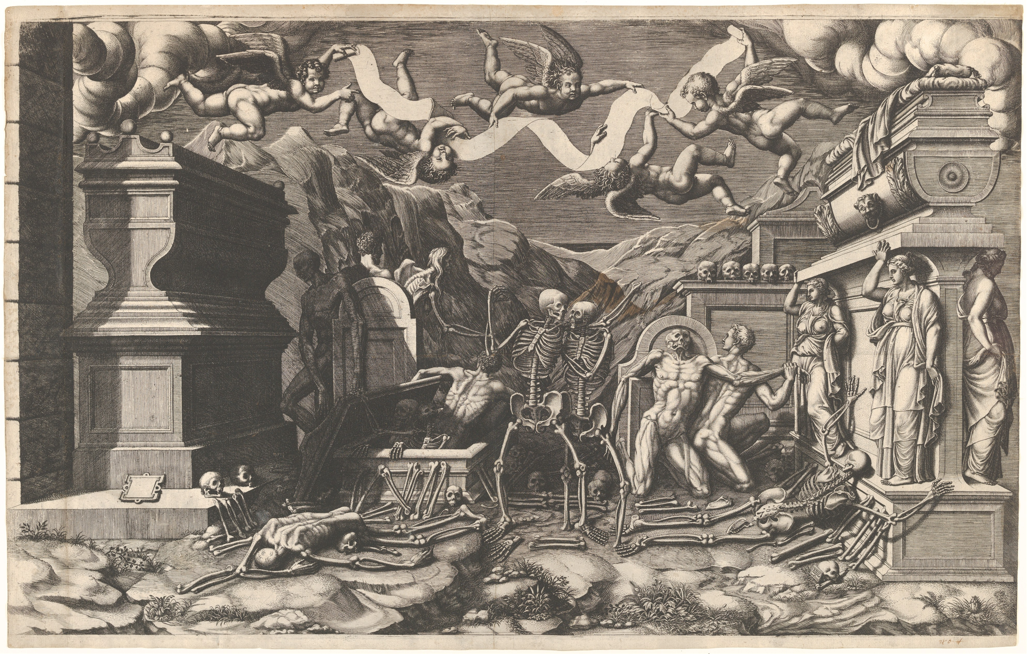
Title: The Vision of Ezekiel. Artist: Giorgio Ghisi (Italian, Mantua ca. 1520–1582 Mantua). Artist: After Giovanni Battista Bertano (Mantua 1516–1576 Mantua) Date: 1554
But Ezekiel’s vision does not stop at recognising death. It is also a prophecy that preaches hope. Ezekiel’s vision is also telling the people that, even if genocide occurs and there is death on every side; even if everyone we know has died; God can bring forth life from dry bones. And the prophecy that proclaims this hope is a discourse of rebellion against the reality imposed around us. It is a prophecy that affirms that even if everyone has died, death will not triumph. This is our faith. This is our vision. The last ABUB Missionary Congress had precisely this vision as its theme: Mission 2006, Living Hope in Jesus.
This is more than strategic optimism. The Christian faith is a discourse of living hope, a hope that sometimes places us in open rebellion against the reality of death around us. Because even if we are surrounded by dry bones, or walking through the valley of the shadow of death, our God is the Lord of life, who brings life into being, who makes tomorrow dawn. This was the hope that kept me going in recent years, when death struck my family. And it was also this living hope that enabled me to continue, many times, throughout these last eight years of service on the ABUB National Board.
And in this last year in particular, I had the opportunity to reflect on my own role on the National Board. Exercising leadership is sometimes a difficult thing. Imagine speaking these words of the prophet to grieving people. Many times we have to decide, assess, and vote. This happens on the National Board, on ABUB’s regional boards, and in any church or organisation. And we create justifications for the exercise of power. We say, “I did what was best for the mission/church/organisation.” But the truth is that, in the exercise of leadership, when it is successful, we often defeat our opponents, those who disagree with us and vote against us, and not infrequently, we hurt people. Even unintentionally, even under the best circumstances. Are these actions justified, or are they merely excuses emptied of love?
So, at the end of my ministry in ABUB, I want to take this opportunity to ask for forgiveness. To each and every one of you, for anything I may have done that hurt someone. The end of a ministry involves letting go of power and influence. It is somewhat melancholic, and somewhat lonely. We enter into self-centred crises: will my participation leave behind more dry bones than branches, more than flowers? Will they keep inviting me to speak at events? (Laughter!)
And here I also have much to be thankful for.
I need to thank every single person who, before me, alongside me, and after me, made ABUB what it is today and what it will be tomorrow. The passage following the Valley of Dry Bones in Ezekiel 37 is a text about the unity of the kingdoms of Judah and Israel in the Old Testament. And unity was, in my experience on the NB, the result of facing difficulties with hope. And there were many difficulties. Lack of staff workers, lack of resources, lack of faith. We went through all of this during these last eight years. But those were the moments that shaped us into what we are today.
The Indian missionary Sadhu Sundar Singh wrote a reflection about silkworms which goes something like this:
“A silkworm was struggling to emerge from its cocoon, and then an ignorant man saw its struggle and suffering and went over to help it escape. But soon after it emerged, it flew low, fell, and died. The other silkworms, which struggled to emerge without help, suffered, but they came out into life and beauty, with strong wings to fly, through their battle for the freshness of existence.” (Common Prayer for Ordinary Radicals)
More than anything, I wish I could be there with you at this Congress, Amanhar. But unfortunately, it was not possible.
So I leave here my prayer that the Lord may shape and form us into the people He wants us to be. That He may have patience when we fall, and when we fail to live out what His love demands of us. That He may give us patience with ourselves and with one another. That He may embrace us with His grace.
Amanhar is coming out of the Valley of Dry Bones when the whole world around us seems to have been overtaken by death. It is leaving the cocoon, through difficulties, in order to fly high. To fly with this new generation of ABU students who are here today. It is life springing forth.
May God bless us, and thank you very much.
________________________________________________________________________________________________________________
*Marcus Vinicius A. B. De Matos served as First Secretary of the National Board of the IFES-Brazil (ABUB) between 2018 and 2026. Previously, he was Special Project Advisor (FALE Network) for ABUB between 2008 and 2010, and an intern with the Communications Office of the Student Missionary Congress Missão 2006, organised by ABUB. He is a Senior Lecturer in Law at Brunel University of London, in the United Kingdom. He holds a PhD in Law from Birkbeck College, and an LLM and LLB from the Federal University of Rio de Janeiro (UFRJ). He is an honorary member of the Brazilian Lawyers Institute (IAB), and a founding member of the Christian Network for Popular Advocacy, the RECAP. He is married to Priscila Vieira, with whom he co-authored the award-winning book Images of Latin America: Media, Culture and Human Rights, and is the father of Aurora. Follow him on Instagram, Bluesky and Twitter (X): @mvdematos. Also follow the Dignidade Blog page on Facebook. The opinions expressed in this text are the sole responsibility of the author.
________________________________________________________________________________________________________________
Read also:
+ Christianity and Human Rights: back to basics
+ Louder Please! 25 Years of SPEAK NETWORK
+ What is the role of the critic?
+ Jesus Fights Back: Easter Torture & Reverse Racism
Referências:
+ Learn more about Rev. Andrew Thompson no site Seen & Unseen.
+ Check the daily prayers at Common Prayer for Ordinary Radicals.
+ Read this text in Portuguese.